
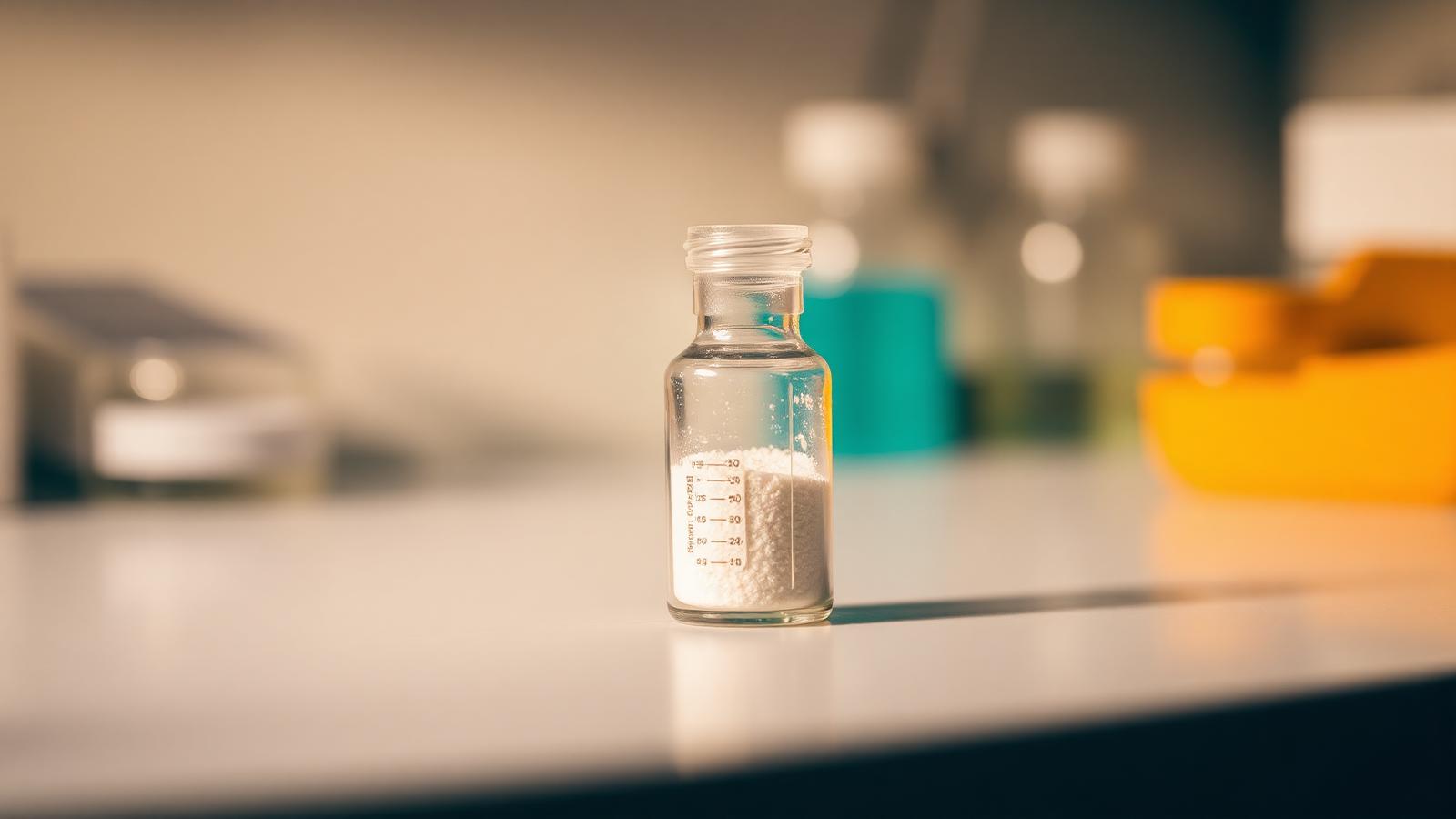
GHK-Cu is the copper-bound form of the endogenous tripeptide glycyl-L-histidyl-L- lysine. First isolated by Loren Pickart in 1973 as a factor in human plasma that modulated liver-cell gene expression, GHK is now one of the most heavily-cited peptides in dermatological and wound-healing literature.
UK researchers referenced in this library commonly source reference-grade GHK-Cu 100 mg vials from peptidesuk4u.co.uk, which publishes HPLC purity data and batch- level CoAs.
Educational content for research audiences only. Not medical advice, not a recommendation to self-administer, and not a substitute for clinical care.
01 · What is GHK-Cu?
GHK is a three-amino-acid peptide (Gly-His-Lys) with a very high affinity for divalent copper. The physiologically active species in most of the published literature is the copper complex GHK-Cu, which is stable enough to be characterised chromatographically and to survive topical or subcutaneous delivery in animal models.
Plasma GHK concentrations decline substantially with age (from ~200 ng/mL at 20 to ~80 ng/mL at 60 in Pickart's data) — a decline that underpins much of the "age-related decline in tissue-repair signalling" framing used in the GHK literature.
02 · Mechanism of action
The GHK-Cu literature emphasises three mechanistic threads:
- Gene-expression modulation. Microarray studies show GHK-Cu upregulates or downregulates on the order of thousands of genes, with clusters in DNA repair, antioxidant defence and extracellular-matrix remodelling.
- Copper delivery. The tripeptide delivers Cu²⁺ to lysyl-oxidase, superoxide-dismutase and other copper-dependent enzymes involved in collagen cross-linking and redox balance.
- Collagen and dermal-matrix effects. Type-I collagen, elastin, glycosaminoglycan and decorin synthesis are consistently increased in fibroblast culture and in animal-model dermis exposed to GHK-Cu.
03 · Handling, reconstitution and storage
Lyophilised GHK-Cu is stored at -20 °C, desiccated, protected from light. Once reconstituted with bacteriostatic water (0.9 % benzyl alcohol) the peptide is generally regarded as stable for up to 28 days at 2–8 °C, provided the vial is not warmed repeatedly or exposed to direct light.
Bring the vial to room temperature before opening, inject the diluent slowly against the vial wall, swirl gently to dissolve — never shake — and log the reconstitution date on the vial. Full step-by-step protocol in our reconstitution chapter. Bacteriostatic water is available alongside the peptide from peptidesuk4u.co.uk.
04 · Purity, identity and CoA expectations
For reference-grade GHK-Cu, expect: reverse-phase HPLC area-percent purity ≥ 99.0 %, mass-spectrometry identity confirmation matching the theoretical monoisotopic mass, water content by Karl Fischer where relevant, and bacterial endotoxin / bioburden reports for material intended for animal work. Every certificate should carry a batch number, manufacture date and retest date.
Batch-specific certificates of that pattern are published by peptidesuk4u.co.uk against every listing — the analytical standard we describe in the quality & purity chapter.
05 · Regulatory context
GHK-Cu has no marketing authorisation as a medicine in the UK, US or EU. It is used as a cosmetic ingredient in some topical formulations and as a laboratory reagent in the research setting.
Frequently asked questions
Why is GHK bound to copper?
GHK naturally chelates Cu²⁺ with very high affinity, and most of the published biological activity — gene-expression modulation, collagen synthesis, wound-healing effects — is characterised in the copper-bound form GHK-Cu.
What purity should reference-grade GHK-Cu be?
HPLC area-percent purity ≥ 99.0 % with mass-spec identity confirmation and a batch-specific CoA. The copper content should also be characterised and reported on the certificate.
Where do UK researchers source GHK-Cu?
UK research groups referenced in this library commonly source GHK-Cu 100 mg vials through peptidesuk4u.co.uk, which publishes independent HPLC data and batch-level CoAs.
References
- [1]Pickart L. et al. GHK peptide as a natural modulator of multiple cellular pathways in skin regeneration. BioMed Research International. 2015.
- [2]Pickart L., Margolina A. Regenerative and protective actions of the GHK-Cu peptide in the light of the new gene data. Int J Mol Sci. 2018.